
A leather jacket can shrink when moisture and heat affect the hide, but there is no dependable home method for making it an exact size smaller. Soaking it, tumble drying it or putting it on a radiator can leave it stiff or misshapen. If yours feels too large, a size exchange or an assessment by a leather alterations specialist gives you a more controlled way to address the fit.
Perhaps the sleeves cover your hands, the waist looks baggy, or a second-hand find is almost right. Before changing the leather, work out which part needs adjusting. A jacket that fits at the shoulders but has long sleeves needs a different solution from one that is too large everywhere.
This guide explains what shrinking does to leather, why popular DIY methods are unreliable, and how to get a better fit without treating your jacket as an experiment. For a broader starting point, read our leather jacket fit guide.
Can you actually shrink a leather jacket
Yes, leather can shrink. That does not mean it will shrink neatly. Leather is a processed animal hide, and its response to water depends on its tanning, surface finish and condition. The Canadian Conservation Institute documents shrinkage, stiffening and staining in certain leathers exposed to water. Its guidance concerns conservation materials, rather than a sizing treatment for modern jackets.
Garment manufacturer deercraft also warns that damp leather can shrink when exposed to heat. The practical lesson is to keep a wet jacket away from concentrated heat, rather than use heat as a fitting tool. A smaller jacket is little use if the leather has hardened or its shape has changed.
There is no universal shrinkage percentage, soaking time or temperature that translates into a UK clothing size. A jacket also includes separate leather panels, a lining, seams and fastenings. Trying to contract the whole garment does not let you choose which measurement changes. Think of the shell and lining as parts that need to keep fitting together, not simply a single piece of material.
Check what is making your jacket feel too large
Try the jacket on indoors while it is completely dry. Wear the layer you would normally use underneath: a T-shirt for mild days, or your usual jumper for autumn and winter. A fit that works over a thin top may feel quite different over knitwear.
1. Check the shoulders first. On a conventional fitted jacket, see where the shoulder seams sit and whether the upper back looks excessively loose. Raglan sleeves and deliberately dropped shoulders need judging against their intended cut.
2. Fasten the front comfortably. Look at the chest and waist, then sit down and reach forward. Keep the room you need for normal movement; a closer silhouette should still be wearable.
3. Look at the sleeves with your arms relaxed, then bend your elbows. Decide whether the problem is excess length, excess width, or simply the way a ribbed cuff gathers the sleeve.
4. Check the design. A relaxed bomber will carry more volume than a fitted biker jacket. Compare your expectations with the product photographs and description.
5. Write down the specific change you want. A note such as sleeves about 3 cm shorter is more useful at a fitting than make the jacket smaller. The specialist can then assess what the construction allows.
For a bomber, use our guide to how a bomber jacket should fit before deciding that its relaxed body needs reducing. Some of the fullness is part of the style.
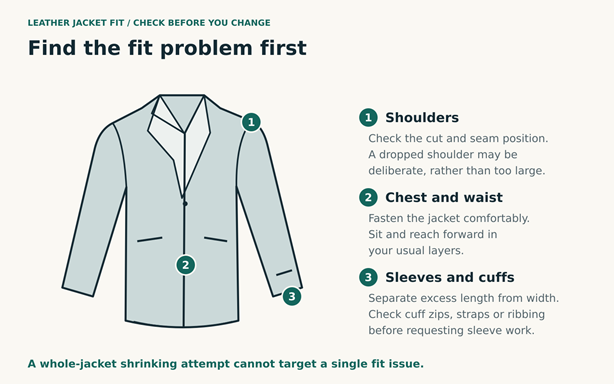
Identify the area that needs changing. A whole-jacket shrinking attempt cannot target one fit problem.
Common shrinking methods and what can go wrong
Most online shrinking advice combines moisture with heat. Those are also conditions that leather-care guidance tells you to avoid. The table below compares the methods with the fit problem they actually solve.
| DIY method | Main concern | Does it control the fit |
| Soaking in hot water | Water can stain or stiffen susceptible leather; heat adds risk. | No reliable control over individual measurements. |
| Washing machine | Machine washing is unsuitable for ordinary leather jackets. Follow the care label. | No targeted sleeve, shoulder or waist adjustment. |
| Tumble dryer | Manufacturers warn against tumble drying leather jackets. | Heat exposure is not a measured alteration. |
| Radiator or hairdryer | Concentrated heat can harden, crack or distort leather. | Local drying does not give a predictable local fit change. |
A care label that permits a particular cleaning method is permission to clean the garment as instructed. It is not a guarantee that the same process can resize it. Avoid substituting a washing or drying programme for an alteration.
A small hidden patch can help assess whether a care product changes colour or texture. It cannot show how a complete jacket will fit after a shrinking attempt. Schott recommends hidden-area testing for cleaning and conditioning products, rather than as a way to approve garment resizing.
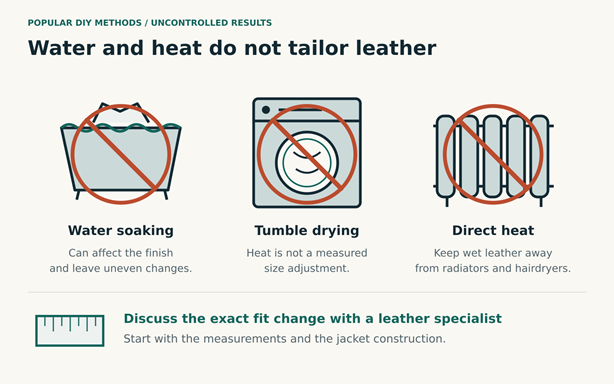
Treat excess size as a fitting problem. Water and heat cannot replace a measured alteration.
How to make a leather jacket fit better
Check size exchange options on a new jacket
Compare the individual measurements in the relevant product size chart, rather than assuming that the next size down will fix everything. Ask whether the chart gives body measurements or finished jacket measurements, and how each measurement is taken. A smaller size may reduce room in places that already fit.
Ask a leather specialist about targeted alterations
For a jacket you already own, book a fitting with someone who regularly alters leather garments. Specialist services can include sleeve shortening, tapering and lining replacement; the available work depends on the particular jacket. The Stitching Room, a UK alterations studio, lists these services for leather jackets.
Use the fitting to separate your essential changes from preferences. Bring the layer you normally wear and point out the area that bothers you. If the sleeves are the only issue, ask about sleeve work before requesting a reduction through the whole body.
| What feels wrong | What to discuss at a fitting |
| Sleeves are too long | Shortening while retaining, or discussing changes to, cuff details and zips. |
| Waist is loose but chest fits | Whether the body can be taken in while preserving pockets and movement. |
| Shoulders and upper body are too large | Whether the required reconstruction is worthwhile, or a different size or cut is preferable. |
| Ribbed cuffs have lost their grip | The condition of the ribbing and whether repair or replacement addresses the problem. |
For example, sleeves that are roughly 3 cm longer than you want do not mean the chest should become smaller too. Record the sleeve issue, then let the specialist check the cuff construction and lining. This is a fitting example, not a promise that every sleeve can be shortened by that amount.
Get a quote before committing
Ask what the alteration includes, whether visible details will change, and how the lining will be handled. Confirm the proposed fit before work starts. Compare the quote with the value the jacket has to you, including its condition and whether you will wear it regularly afterwards.
A cherished jacket may justify specialist work. If the proportions are wrong throughout, choosing another cut can be the more practical answer. Neither option requires deliberately damaging the hide to discover whether it becomes smaller.
Why the leather type and finish matter
Smooth leather, suede and nubuck need different care. With an unfamiliar or vintage jacket, identify the material and read the care label before using any liquid or product.
UK Leather Jackets advises against general creams and conditioners on suede, nubuck, sheepskin or unprotected aniline leather unless suitability is expressly confirmed. It also notes that the finish matters, rather than simply the animal hide. That is why lambskin and cowhide do not come with a dependable home shrinking formula.
If the jacket is described as faux leather, follow its own care instructions rather than guidance intended for real hide. A mixed-material jacket also needs care that accounts for all its components. Check the instructions for knitted cuffs, panels and linings as well as the outer shell before choosing a cleaning treatment.
What to do if you have already soaked the jacket
Stop applying heat. If the jacket is still wet, the immediate priority is to let it dry without forcing a further change. Do not repeat the soaking process because the first attempt has not produced the fit you wanted.
1. Gently blot visible moisture with a clean, soft, absorbent cloth. Avoid rubbing, wringing or twisting the leather.
2. Let it dry naturally at room temperature with air circulating around it, away from direct heat and sunlight.
3. Support its shape. A lightly damp jacket can use a broad, shaped hanger. A heavily saturated, unusually heavy garment needs careful support so its weight does not pull the shoulders out of shape.
4. Once it is completely dry, check for stiffness, staining and distortion. Ask a leather-care specialist to assess noticeable damage.
Only use a cleaner or conditioner that is compatible with the leather and permitted by the care instructions. Test it in a concealed area and allow the test to dry before assessing colour and texture. Conditioner is a care treatment, not a dependable way to return a distorted jacket to its original size.
For ongoing cleaning and storage, see our complete leather jacket care guide. In a UK home, resist the temptation to speed things up beside the central heating after a wet journey.
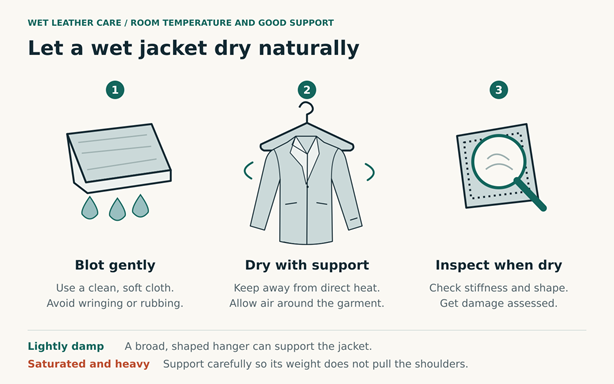
Dry naturally and support the garment. For a saturated jacket, avoid hanging its full weight from unsupported shoulders.
Frequently asked questions
Can you shrink a leather jacket by one size
You cannot reliably translate home shrinkage into one clothing size. Sizes and cuts vary, and the shoulders, sleeves and body may need different changes. Compare the relevant measurements and discuss an exchange or specialist alteration.
Will hot water shrink a leather jacket
It may cause shrinkage, but it can also leave the leather stiff, stained or distorted. The result depends on the material and its condition. Hot water is not a dependable fitting method.
Can you put a leather jacket in a tumble dryer
Do not use a tumble dryer to resize it. Schott’s leather-care guidance specifically advises natural drying away from heat. Follow your own garment’s care label for cleaning and drying.
Can you shrink just the sleeves
Wetting or heating a sleeve does not provide a controlled sleeve alteration. Ask a leather specialist whether shortening or tapering is possible, particularly if the cuffs have zips, straps or ribbing.
Will wearing a leather jacket make it smaller
Ordinary wear is not a shrinking method. Leather may soften and mould slightly with use; Schott describes limited stretching in areas that move. A jacket that is too large should be assessed for fit rather than expected to tighten itself.
Can conditioner reverse a shrinking mistake
Do not rely on it to restore the original dimensions. Suitable care may help maintain flexibility, but a stiff or distorted jacket needs assessment. Avoid pulling it forcibly or adding more products without checking compatibility.
Choose the fit before changing the leather
When deciding how to shrink a leather jacket, start by asking what actually needs to change. Preserve room for movement, identify the specific fit issue, and choose an exchange or a measured alteration where appropriate. This keeps the decision focused on a jacket you can comfortably wear.
If you are comparing a replacement, browse our men’s leather jackets or women’s leather jackets, then check the individual product’s cut and size information with your usual layers in mind.